
Get it wrong, and you're either overpaying for computing power you don't need, or bottlenecking a data-heavy operation with a controller that can't keep up. The industrial control and factory automation market is projected to grow from $274.99 billion in 2025 to $435.24 billion by 2030, a 9.6% CAGR, meaning more manufacturers are making this exact decision right now.
This guide breaks down the real differences, where each technology fits, and when you actually need both.
TL;DR
- Industrial PCs deliver flexible, high-performance computing with modern OS support for data-heavy, multi-application environments
- PLCs win on cost and reliability for repetitive, simple control tasks
- Key selection factors: processing needs, environment, budget, programming skillset, and integration requirements
- Many facilities run hybrid architectures — PLCs for control, IPCs for HMI and data visualization
Industrial PC vs PLC: Quick Comparison
| Factor | Industrial PC | PLC |
|---|---|---|
| Cost | Higher upfront cost, but a single IPC platform can replace multiple redundant hardware components in complex setups | Lower upfront cost for basic discrete control; no operating system, no licensing, minimal peripherals |
| Processing Power & Flexibility | Runs full operating systems (Windows IoT, Linux); handles SCADA, HMI, image processing, and data logging simultaneously | Executes dedicated cyclic logic: reads inputs, runs the program, updates outputs, repeat. Predictable, but not built for heavy computation |
| Durability & Environmental Resistance | Model-dependent. Ratings range from IP65 to IP69K, with fanless designs and extended temperature tolerances available | Rugged by design for panel-mount installation in harsh plant environments |
| Programming | Standard languages such as C++ and C#, with real-time execution on platforms like Beckhoff's IPCs | IEC 61131-3: Ladder Diagram, Structured Text, Function Block Diagram, and Sequential Function Chart |
| Lifespan & Maintenance | Component quality and environmental protection drive lifespan; industrial-grade units with stable BOMs outlast commercial-class parts | Field examples show original hardware still running after 30+ years in some installations |

What is an Industrial PC?
An Industrial PC (IPC) is a ruggedized computer built with industrial-grade components — fanless designs, sealed casings, wide temperature tolerance — for environments that would destroy a standard office computer.
Unlike a PLC, an IPC runs a full operating system. That supports multitasking on one platform: SCADA visualization, HMI control, data logging, and machine-vision processing. Beckhoff, for instance, positions its Industrial PCs for machine control, data acquisition, and image processing, with fanless and IP65-rated options available.
IPCs come in several form factors:
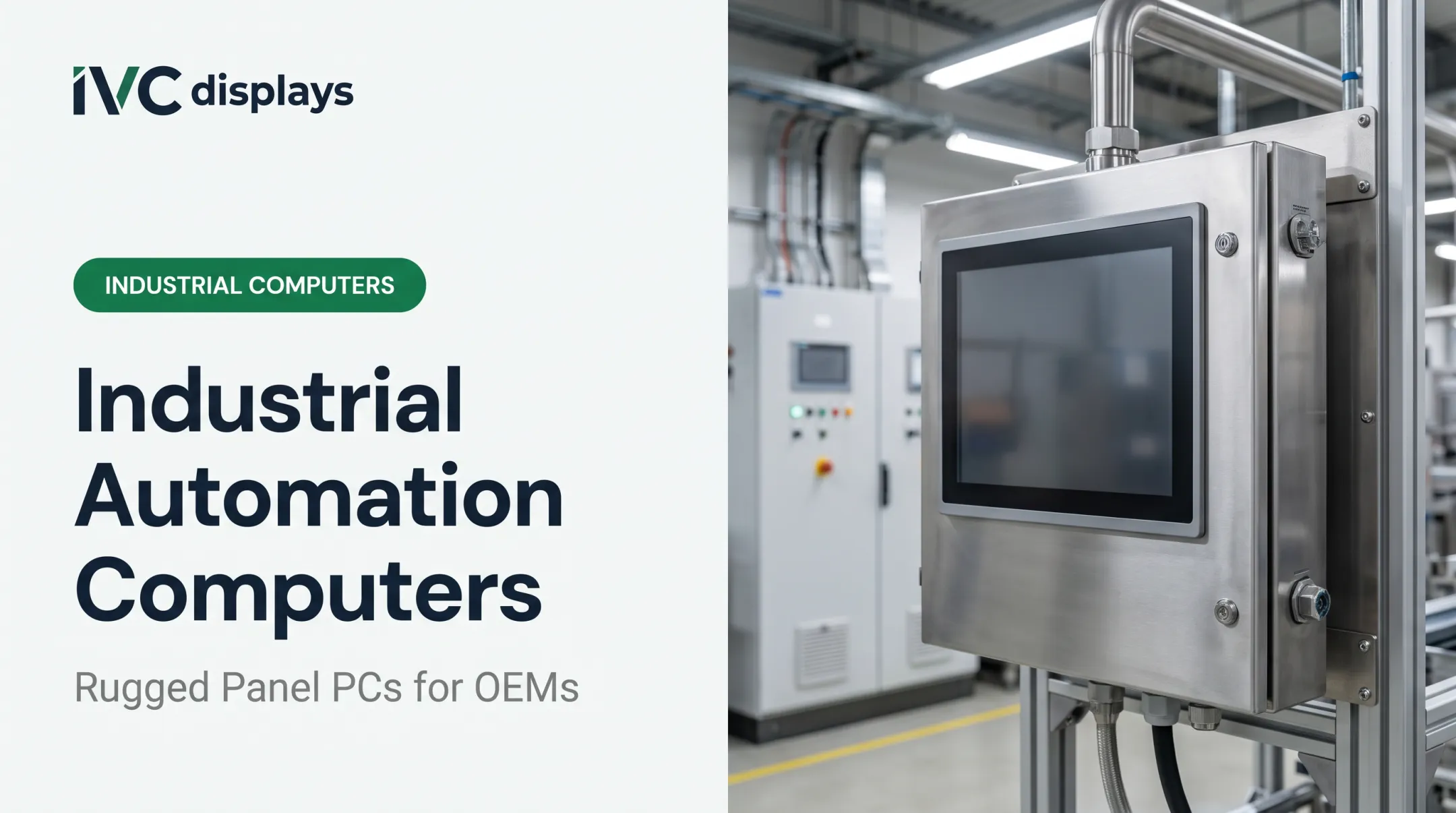
- Panel PCs (touchscreen, integrated display)
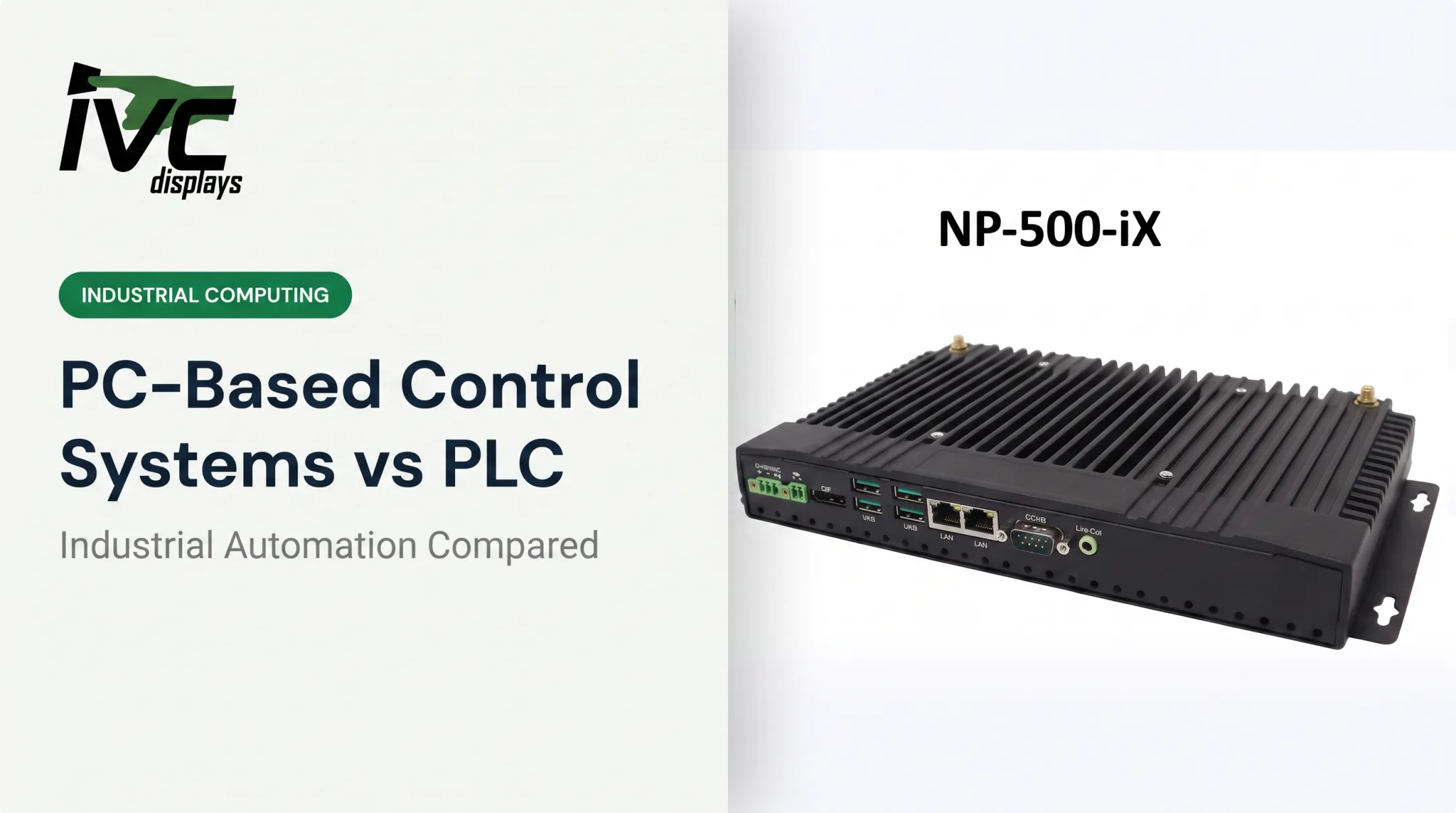
- Box PCs / embedded computers
- Rugged tablets
- Vehicle-mount computers
- Marine-grade systems
IVC Displays builds across most of these categories:
- NP-6XXS Light Industrial Computer Series — fanless Intel Atom or Celeron designs, up to 32GB DDR4, IP66-rated aluminum bezel
- IVC-XXPC-P Heavy Industrial Computer Series — sealed, fanless hardware rated from -20°C to +70°C
- NP-9XX-MA Series — marine systems with IEC 60945, IACS E10, and DNV certifications

Use Cases of Industrial PCs
IPCs fit wherever a plant needs computing power alongside control, including production-line HMIs, SCADA dashboards, machine-vision quality checks, and IoT-connected equipment.
Industries where rugged computing dominates:
- Food processing (washdown environments, quality imaging)
- Pharmaceuticals (hygienic, sealed enclosures)
- Oil and gas (extreme temperature, vibration)
- Marine and offshore (corrosion resistance, certification requirements)
A June 2024 Teguar case study showed an embedded PC in a food-processing cabinet collecting camera data for quality checks. Installation stayed simple enough for the customer's own maintenance team.
IVC Displays has similar documented deployments. McCall Farms runs Light Industrial Computers to automate canning operations. NOAA uses a Heavy Duty Industrial Computer to monitor engine performance aboard the Ship Fairweather.

What is a PLC?
A Programmable Logic Controller (PLC) is a purpose-built controller running a proprietary microprocessor and operating system, designed specifically for scan-based logic execution. Rockwell Automation defines it simply: an industrial computer that monitors inputs, processes logic, and controls outputs using programmable memory.
The scan cycle is deterministic. Siemens documents it precisely: the CPU updates outputs, reads inputs, then executes the user program from start to finish — repeating continuously. That predictability is the PLC's core strength.
Key benefits:
- Reliable continuous operation
- Closed architecture with a smaller cyberattack surface
- Low power draw
- Long service life with minimal moving parts
NIST guidance still notes many OT devices lack encryption and password protection, so closed architecture alone is not a full security strategy.
PLC variations include:
- Compact PLCs (all-in-one, smaller footprint)
- Modular PLCs (expandable I/O and processing)
- Programmable Automation Controllers, or PACs (blend PLC logic with more advanced computing)
Use Cases of PLCs
PLCs handle repetitive, well-defined control tasks: conveyor systems, gate automation, safety interlocks, and anything requiring split-second, predictable timing.
Common industries:
- Automotive assembly (repetitive, high-speed sequencing)
- Packaging (consistent, cyclical operations)
- Power grid management (safety-critical, long-term reliability)
Automation World's 2022 controller comparison quotes an integrator who was replacing PLC installations running on original hardware installed upwards of 30 years earlier. That's not a formal reliability study, but it's a real-world signal: a well-maintained PLC can outlast several generations of general-purpose computing hardware.
Industrial PC vs PLC: Which is Better?
Neither wins outright. The right answer depends on weighing five factors:
- Processing complexity — simple on/off logic or data-heavy analysis?
- Environmental exposure — washdown, marine, extreme temperature, or controlled indoor space?
- Budget — upfront cost versus long-term flexibility?
- Longevity — do you need 20+ years of unchanged operation, or will requirements evolve?
- IT/OT skillset — does your team know Ladder Logic, C++, or both?
Choose a PLC for simple, repetitive, cost-sensitive control tasks where deterministic timing matters most.
Choose an Industrial PC for data-intensive, multi-application, or IoT-connected operations that need visualization, logging, or image processing.
Most modern facilities don't pick one exclusively. They pair a PLC for dedicated control with an IPC for HMI, data logging, and connectivity. That combination delivers deterministic control and flexible computing in the same system.

Real-World Example: Choosing the Right Hardware for Harsh Environments
TIMET (Timet Metals), a titanium manufacturer, uses an IVC Displays Light Industrial Computer on the plant floor. Titanium production runs under heat, particulate, and continuous operation as standard conditions, not exceptions.
In settings like this, a PLC still handles discrete machine control. The industrial PC runs the HMI, visualization, and data tasks that need a full computing platform—and it has to survive the same floor conditions. Standard commercial PCs fail faster here and need more frequent replacement.
When rugged industrial computing is the right call:
- Continuous shifts with no tolerance for unplanned downtime
- Heat, dust, vibration, or moisture beyond office-grade tolerances
- Multi-year platform life without redesign or replacement
If your operation faces similar conditions, explore IVC Displays' light industrial computers and industrial touch screen monitors built for demanding environments.
Conclusion
There's no universal winner between Industrial PCs and PLCs. The right choice matches your operational context: processing needs, environment, budget, and team skillset.
Match those factors well and you reduce downtime, cut long-term costs, and improve production reliability across manufacturing, automation, and logistics. Miss the mark, and you may end up replacing hardware, retraining staff, or redesigning your control architecture sooner than planned.
If your application points toward an Industrial PC, IVC Displays builds rugged panel PCs and industrial computers for harsh environments—with custom engineering and long-term lifecycle support when standard configurations are not enough.
Frequently Asked Questions
What are the key differences between a PLC and an industrial PC?
PLCs run dedicated scan-based logic on proprietary hardware, built for reliability in repetitive control tasks. Industrial PCs run full operating systems (Windows IoT, Linux), offering more processing power and flexibility for data-heavy, multi-application work.
What does industrial PC mean?
An industrial PC is a ruggedized, industrial-grade computer built to withstand harsh environments (heat, dust, vibration, moisture) while still running standard operating systems like Windows or Linux.
Can a PLC and an industrial PC work together in the same system?
Yes. Hybrid setups are common, with the PLC handling dedicated control logic while the IPC manages HMI, data logging, and connectivity to broader plant systems.
Which is more cost-effective, a PLC or an industrial PC?
PLCs are typically cheaper upfront for simple, single-purpose control tasks. IPCs often deliver better long-term value when a facility needs multiple functions (control, visualization, and data logging) on one platform.
How long do industrial PCs and PLCs typically last in harsh environments?
PLCs can run reliably for decades thanks to simple architecture, with field examples exceeding 30 years. IPC lifespan varies by component quality and environmental protection, with light industrial units generally rated for 7 to 15 years.
Do industrial PCs require special programming skills compared to PLCs?
They require different skills, not necessarily more specialized ones. IPCs typically use general-purpose languages like C++, C#, or Python; PLCs use IEC 61131-3 languages such as Ladder Logic, Structured Text, and Function Block Diagram.