
Many buyers struggle to tell the difference between edge-lit and full-array configurations, or between LED-backlit LCD and older CCFL technology. That confusion gets expensive fast. The wrong backlight or panel type hurts readability, shortens lifespan, spikes power draw, and drives unplanned downtime in harsh environments.
This guide breaks down LED-backlit LCD versus CCFL-backlit LCD and OLED, plus the difference between edge-lit and full-array LED types, so you can pick the right rugged display for your application.
TL;DR
- LED-backlit LCDs use LEDs to light a liquid crystal panel that cannot emit light on its own
- Edge-lit stays thin and efficient; full-array/direct-lit delivers higher brightness and contrast
- LED backlighting beats CCFL on energy efficiency, brightness, and lifespan
- OLED delivers better contrast but falls short on brightness and lifespan for 24/7 industrial use
- Pick based on ambient light, budget, and how much environmental durability you need
LED-Backlit LCD vs Alternatives: Quick Comparison
Use this side-by-side view when comparing backlight options for industrial HMIs, panel PCs, and open-frame monitors.
| Factor | LED-Backlit LCD | CCFL-Backlit LCD | OLED |
|---|---|---|---|
| Light source | LED array (edge or rear) | Fluorescent tube + inverter | Self-emitting pixels |
| Energy efficiency | ~21% lower power draw than same-size CCFL (EIZO, 2011) | Higher draw; needs AC inverter | Efficient on dark content; higher on white screens |
| Lifespan | Up to 120,000 hours reported | Typically 40,000–60,000 hours | ~20,000 hours to below 50% luminance (industrial modules) |
| Brightness | 450–1,500+ nits, model-dependent | Moderate; degrades over time | 60–80 nits in industrial-grade modules |
| Cost | Moderate; scales with brightness and zones | Lower upfront; higher maintenance | Higher per-unit cost |

What Is an LED-Backlit LCD?
An LED-backlit LCD is a liquid crystal panel illuminated by an array of LEDs rather than a self-emitting screen. The liquid crystals still do the work of forming the image; the LEDs just supply the light behind them. This matters because "LED display" often gets used loosely: it doesn't mean each pixel emits its own light, the way OLED does.
For industrial buyers, this architecture translates into practical benefits:
- Lower power consumption compared to fluorescent backlighting
- Longer operational life with fewer moving parts to fail
- Reduced heat output, which matters in sealed enclosures
- Thinner enclosure design, useful for space-constrained mounting
The energy case is well documented. EIZO reported roughly 21% lower power consumption for LED-backlit diagnostic monitors versus same-size CCFL models, and in a separate release described a 47% energy savings versus conventional CCFL.
Treat these as model-specific benchmarks rather than a universal rule. Actual savings depend on brightness settings, driver design, and panel size.
Types of LED-Backlit LCD
Two configurations dominate industrial deployments:
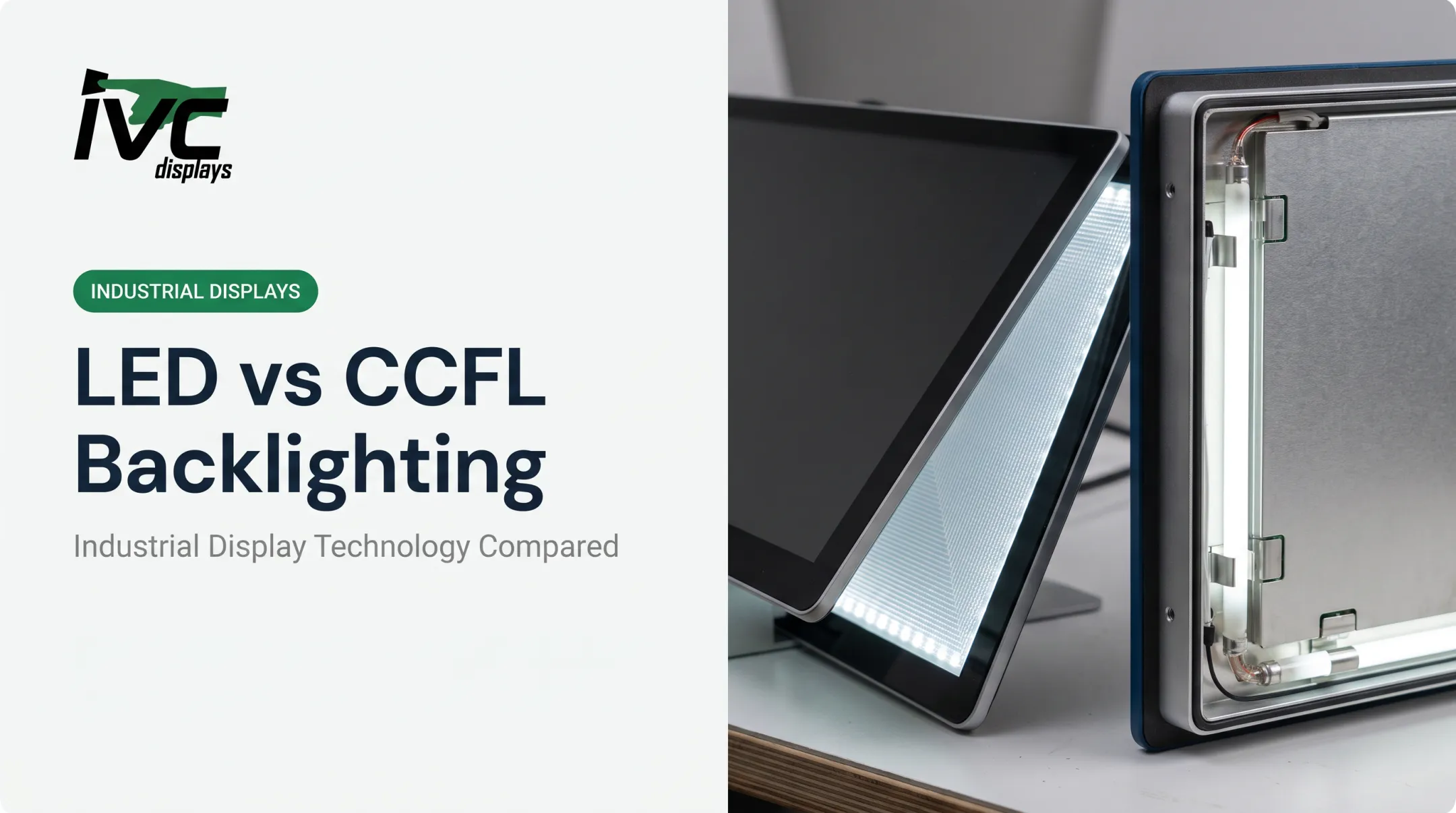
Edge-lit places LEDs along the panel's edge and uses a light guide to spread illumination across the screen. The result is a thinner design and lower power draw, a strong fit for compact industrial monitors where enclosure depth is tight.
Full-array (or direct-lit) mounts LEDs in a grid behind the entire panel. Brightness is more even, and independently controlled zones enable better contrast through local dimming. Choose this for larger displays or applications that need uniform brightness across the screen.

Neither configuration is universally better. The right pick is a tradeoff between depth, power budget, and contrast requirements.
Use Cases of LED-Backlit LCD
LED-backlit LCD technology powers displays across industrial operations:
- HMIs and SCADA terminals on production lines
- Panel PCs for machine control and automation
- Control room monitors requiring long duty cycles
- Vehicle-mount computers in logistics and transportation
Industries where this technology dominates include manufacturing, logistics, automation, marine, and defense.
In marine applications, panel PCs must handle vibration, moisture, and salt exposure while staying readable on a bridge or in an engine room. Those conditions push buyers toward ruggedized LED-backlit panels over consumer-grade alternatives.
At IVC Displays, we engineer rugged panel PCs and industrial monitors with LED-backlit LCD technology built for long-term reliability in harsh environments, including extreme temperatures and washdown conditions.
Our light industrial computers, for example, run in stainless-steel, sealed configurations rated up to IP69K for food-processing washdown. Marine-grade panel PCs handle shipboard navigation and engine-monitoring duties.

LED-Backlit LCD vs OLED and CCFL: Which Is Better for Industrial Use?
Choosing between these three technologies comes down to four factors: sunlight readability, temperature tolerance, expected duty cycle, and total cost of ownership. On all four, industrial LED-backlit LCD is the practical choice for most deployments.
OLED contrast comes at a cost. True blacks and per-pixel emission give OLED excellent contrast ratios. But industrial OLED modules top out around 60–80 cd/m² (Winstar, 2022), nowhere near what's needed for outdoor or high-glare environments.
Worse, continuous static imagery (think a fixed HMI layout or alarm banner) risks permanent image retention, according to Sony's own guidance on OLED burn-in. That makes OLED a poor fit for 24/7 industrial displays running the same interface for months at a time.
CCFL is largely obsolete for new deployments. It requires a high-voltage AC inverter, contains mercury, and suffers more in temperature extremes. Typical CCFL life runs 40,000–60,000 hours, versus up to 120,000 hours for LED. Unless you're maintaining legacy equipment, there's little reason to spec CCFL into a new industrial monitor.
Here's a quick decision framework:
- Outdoor or high-brightness environments → full-array LED-backlit LCD
- Compact, low-power devices → edge-lit LED-backlit LCD
- 24/7 industrial or outdoor applications → avoid OLED and CCFL entirely

IVC Displays' rugged panel PCs and open-frame monitors use industrial-grade LED-backlit LCD panels built for vibration, moisture, and temperature extremes in oil & gas, food processing, and defense. Light industrial computers operate across roughly −20°C to 60°C (−4°F to 140°F); stainless-steel waterproof systems run −10°C to 60°C (14°F to 140°F). Those ranges keep displays functional where OLED and CCFL alternatives typically fail.
Real-World Example
TIMET (Timet Metals) relies on an IVC Displays light industrial computer to support titanium manufacturing, a production environment where heat, dust, and continuous operation stress standard computing hardware.
Titanium production runs demanding, high-temperature processes around the clock. Facilities like this need panel PCs that stay readable and operational through:
- Vibration and particulate exposure
- Long duty cycles without downtime
- Heat that accelerates fluorescent backlight degradation
- High-voltage inverter failures common to older CCFL systems
Fanless, LED-backlit industrial hardware built for automation and machine control avoids the flicker, warm-up delays, and shorter service life of legacy displays. Matching display technology to the operating environment—not the cheapest or brightest option—is what keeps production lines running.
If your operation faces similar conditions, explore IVC Displays' rugged panel PCs and industrial monitors built for harsh-environment applications.
Conclusion
The right display depends on ambient lighting, budget, expected service life, and how much environmental abuse the hardware must survive.
For demanding industrial settings, purpose-built LED-backlit LCD hardware delivers durability and reliability that generic commercial displays can't match. IVC Displays builds that reliability into the enclosure, backlight, and thermal design, which cuts downtime and maintenance cost over the life of the equipment.
Frequently Asked Questions
What is an LED-backlit LCD display?
It's an LCD panel illuminated by an array of LED bulbs rather than a screen that generates its own light. The liquid crystals control the image; the LEDs only provide backlighting.
Which is better: LED-backlit LCD or OLED?
OLED offers superior contrast and true blacks. LED-backlit LCD delivers better brightness, longer lifespan, and lower cost, so it is usually the stronger choice for industrial applications.
What's the difference between edge-lit and full-array LED backlighting?
Edge-lit places LEDs along the panel's edge for a thinner, more power-efficient design. Full-array mounts LEDs in a grid behind the screen for more even brightness and better contrast.
Is LED-backlit LCD better than CCFL-backlit LCD?
Yes. LED backlighting is more energy-efficient and brighter than CCFL, lasts longer, and avoids CCFL’s bulky high-voltage inverter and mercury content.
How long do LED-backlit LCD displays typically last?
LED backlights can last up to 120,000 hours, though industrial-rated units commonly specify 50,000 hours minimum. Ruggedized enclosures and thermal management can extend service life further.
Are LED-backlit LCDs suitable for outdoor or harsh industrial environments?
Yes, when paired with high-brightness, ruggedized panel design. IVC Displays' industrial monitors are built with sealed enclosures and sunlight-readable panels for exactly these conditions.