
The truth is, OEM means different things depending on where you're standing. A consumer buying a bare hard drive off a marketplace site and a manufacturing company sourcing rugged computers for industrial equipment are both dealing with "OEM," but the stakes and the definitions shift significantly.
This article breaks down what OEM PC actually means, how it differs from system integrator (SI) products, and how the term applies in industrial computing, where it's less about stripped-down packaging and more about engineering equipment to survive extreme environments.
Key Takeaways
- OEM means Original Equipment Manufacturer: a firm that builds hardware used in another company’s finished product.
- OEM PC parts match retail core hardware, with less packaging, fewer accessories, and reduced support.
- Industrial OEMs build custom computing hardware for integration into other companies’ machinery.
- Lower OEM prices often mean shorter warranties, no documentation, and limited support.
What Does OEM PC Mean?
In the PC world, OEM refers to companies like Dell, HP, Lenovo, and Asus that assemble and sell finished computers under their own brand using parts sourced from other manufacturers. The chips, drives, and boards inside a Dell desktop rarely come from Dell itself.
The term also works as a verb: "to OEM a part" means buying a component wholesale or in bulk rather than at retail. This is a B2B relationship: a component maker selling to a brand or system builder. Consumers have loosely borrowed the term to describe bare, stripped-down products they buy directly.
Common OEM PC products include:
- CPUs, hard drives, and optical drives
- Motherboards and graphics cards
- OEM versions of Windows
What's typically missing from OEM products:
- Retail packaging and manuals
- Bundled cables and coolers
- Pre-installed software or accessories
A real pricing snapshot
Intel distinguishes between the two channels: boxed products are individually packaged for retail purchase, while tray processors are sold in bulk to OEMs for system integration and aren't individually packaged according to Intel's own documentation.
A recent Newegg comparison of the Intel Core i7-14700K showed the boxed version at roughly $381, while a tray listing from a third-party marketplace seller ran $514.99 with no cooler included. That's not proof OEM is always pricier. It shows that channel, seller, and fulfillment matter more than the "OEM" label itself.

OEM vs. Original vs. System Integrator: Clearing Up Confusion
Is OEM the Same as Original?
Physically, yes, usually. The hardware inside an OEM optical drive or CPU is generally identical to its retail counterpart. What differs is packaging, accessories, warranty terms, and support.
Western Digital confirms this directly: OEM and retail drives look the same and differ only by packaging, model number, and serial number. But OEM drives don't receive the manufacturer's warranty or customer service. That responsibility shifts to whoever built the finished system.
Near the end of a product's lifecycle, OEM stock can actually cost more than retail—it becomes scarce spare inventory rather than a bulk discount item.
OEM vs. System Integrator (SI)
These terms get mixed up often, but the distinction matters:
- OEMs typically operate as large corporations (Dell, HP, Lenovo), building branded systems at massive scale for global markets
- SIs stay smaller and more boutique (Origin PC, iBuyPower), assembling systems from standard, off-the-shelf parts
OEMs sometimes use proprietary cases, motherboards, or power supplies that complicate upgrades or repairs down the line. SIs, by contrast, tend to stick with standardized components that are easier to swap out.
All OEMs are technically system integrators, but not all SIs are OEMs. An SI builds systems; an OEM builds systems and sells them under its own brand at scale.

Should You Buy OEM PC Hardware or Software?
OEM hardware’s main appeal is lower upfront cost, especially at volume. The tradeoffs are real:
- Shorter or nonexistent warranty coverage
- Missing documentation and manufacturer support
- No bundled accessories (cables, coolers, mounting hardware)
Practical guidance: OEM works well for basic add-ons like extra drives or accessories, where the risk stays low. Critical parts such as CPUs or motherboards are riskier unless you can supply the missing pieces yourself—coolers, cables, docs, and support included.
What about OEM Windows?
OEM Windows licenses cost less but stay permanently tied to the device they ship on. Under Microsoft’s Windows 11 OEM terms, a license can transfer only with that physical device—not to another machine or shared across devices.
Support routes differently too: Microsoft sends most OEM Windows issues to the device manufacturer, not to Microsoft support.
How OEM Works Beyond Consumer PCs: Industrial and Custom Computing
Outside the consumer world, OEM takes on a different meaning entirely. In industrial and enterprise contexts, an OEM is a manufacturer that designs and supplies computing hardware built for integration directly into another company's machinery, vehicles, or control systems.
Industries relying on this model include:
- Manufacturing automation
- Food processing
- Oil and gas
- Marine and offshore operations
- Defense
- Logistics
Why not build it in-house?
Equipment builders often prefer partnering with an OEM computing manufacturer rather than developing hardware internally. Three reasons drive this:
- Faster time-to-market: no need to design, test, and validate a computing platform from scratch.
- Specialized engineering expertise: rugged computing requires different skills than building consumer electronics.
- Proven reliability in harsh conditions: extreme temperatures, vibration, dust, and moisture demand purpose-built solutions, not adapted consumer parts.
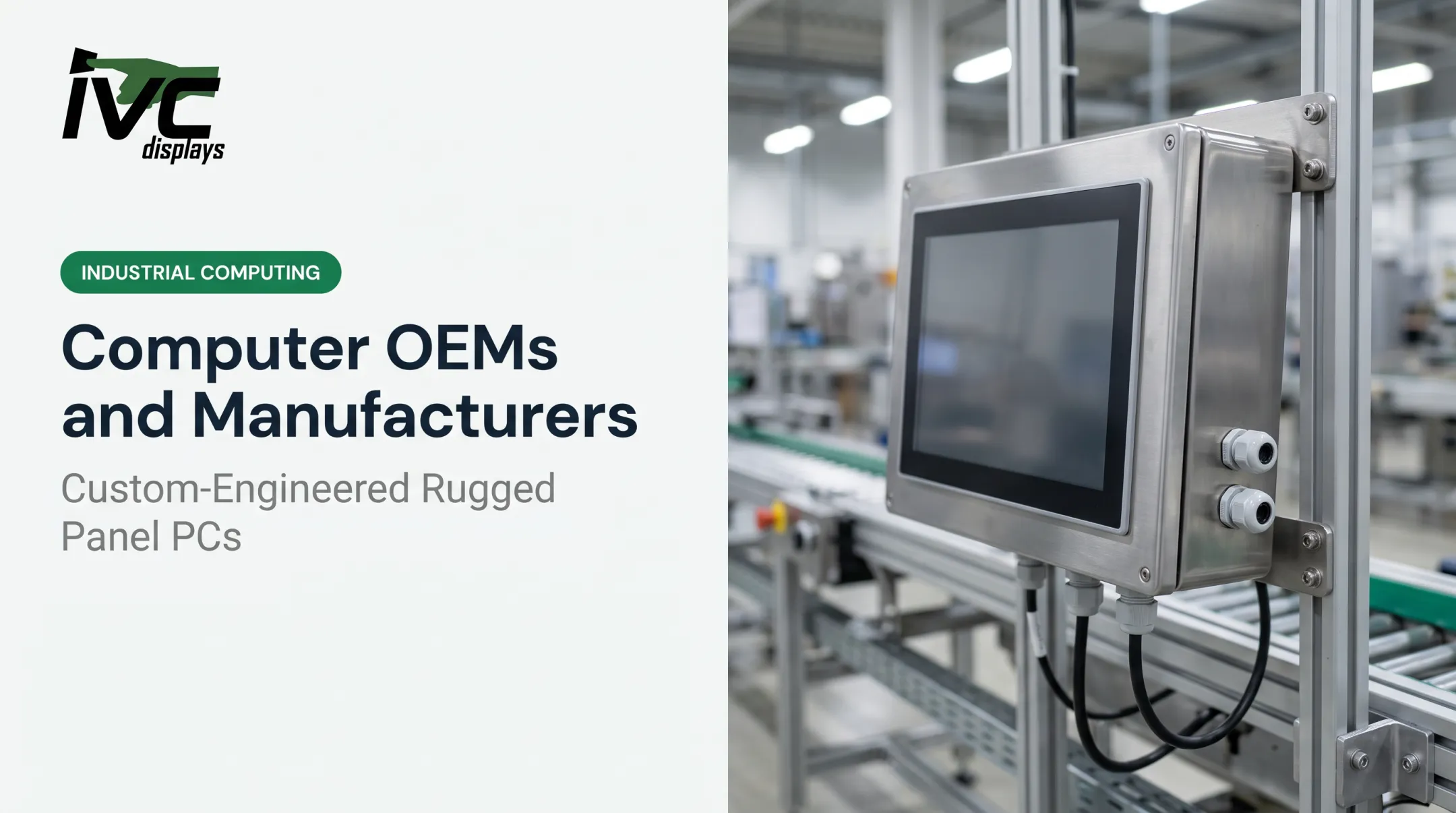
IVC Displays supplies rugged panel PCs, industrial monitors, and marine-grade or washdown systems engineered for OEM integration into other companies' equipment.
Examples from the lineup:
- NP-9XXi medium industrial panel PCs: 12.1" to 21.5" with IP66 front-panel protection for HMI and SCADA integration
- NP-9XX-MA marine-grade panel PCs: IEC 60945, IACS E10, and DNV certified for shipboard and offshore controls
- Open-frame monitors: built for direct install into kiosks, control panels, and custom OEM equipment without an external enclosure
IVC's documented customers illustrate the range: TIMET uses IVC hardware in titanium manufacturing, McCall Farms integrates it into canning automation, and BioCold Environmental relies on it for environmental chamber control.

The key difference from consumer OEM: industrial OEM hardware is engineered for durability, not cost-cutting on packaging.
Standard configurations typically ship within days to a couple of weeks. Custom-engineered systems—with modified enclosures, I/O, or mounting—generally take several weeks for application-specific testing and quality assurance.
Where to Buy OEM PC Parts and What to Watch For
OEM components are commonly sold through major online retailers like Newegg and through authorized distributors—there is no single dedicated OEM marketplace. Watch for listing terms that signal OEM status even when the word "OEM" never appears:
- "Tray" — bulk-packaged processors, sold without retail packaging
- "Bare" — components without accessories or software
- "Bulk" — wholesale packaging intended for system builders
Before purchasing, verify exactly what's included:
- Cables, coolers, and mounting hardware
- Manuals and any bundled software
- Warranty terms and manufacturer support eligibility

A part number match confirms you're getting the right component. The listing fine print still decides which accessories and support ship with it.
Frequently Asked Questions
What is an OEM PC?
An OEM PC is a computer built by a large manufacturer using components sourced from other companies, then sold under the manufacturer's own brand. This differs from a custom-built PC assembled by a system builder or integrator.
Is OEM as good as original?
The underlying hardware is typically identical. OEM versions simply lack full packaging, accessories, documentation, and warranty coverage compared to their retail counterparts.
What does OEM stand for?
OEM stands for Original Equipment Manufacturer, a company that makes parts or products used or rebranded by another company.
Is it safe to buy OEM computer parts?
Generally, yes. OEM parts are usually the same quality as retail parts. Just confirm warranty terms and included accessories before buying, since support responsibility often falls to the seller or system builder.
Can businesses request custom OEM computing hardware?
Yes. Many industrial hardware manufacturers, including rugged PC makers like IVC Displays, offer OEM integration services to build custom computing solutions tailored to specific equipment and environments.